
Hey there! I'm a supplier of exoskeleton hands, and today I wanna chat about how these cool gadgets support the user's hand muscles.
First off, let's get into what an exoskeleton hand actually is. It's basically a wearable device that's designed to assist and enhance the function of the human hand. It can be used for a bunch of different reasons, like rehabilitation after an injury or stroke, or even to help people with disabilities perform daily tasks more easily.
So, how does it support the hand muscles? Well, one of the main ways is through a process called assistive force. The exoskeleton hand is equipped with motors and sensors that can detect the user's intention to move their hand. When the user tries to make a movement, the exoskeleton hand can provide an extra boost of force to help them complete the motion. This is especially helpful for people who have weakened hand muscles due to an injury or a medical condition.
For example, let's say someone has had a stroke and has lost some of the strength in their hand. When they try to pick up a cup, the exoskeleton hand can sense the movement and provide additional force to make it easier for them to grasp the cup. This not only helps them perform the task but also helps to strengthen their hand muscles over time.
Another way the exoskeleton hand supports the hand muscles is through feedback. The sensors in the device can detect the position and movement of the hand and provide feedback to the user. This feedback can be in the form of vibrations, sounds, or visual cues. By receiving this feedback, the user can learn to control their hand movements more effectively and improve their muscle strength and coordination.
For instance, if the user is trying to make a precise movement, like threading a needle, the exoskeleton hand can provide feedback to let them know if they're on the right track. This helps them make adjustments and improve their technique, which in turn helps to strengthen their hand muscles.
The exoskeleton hand also offers adjustable support. Different users have different needs, and the exoskeleton hand can be customized to provide the right level of support for each individual. This means that the user can start with a lower level of support and gradually increase it as their hand muscles get stronger.
Let's talk about some of the specific applications of exoskeleton hands. One area where they're really useful is in rehabilitation. After a hand injury or stroke, patients often need to undergo physical therapy to regain their hand function. Exoskeleton hands can be used as part of a rehabilitation program to provide targeted support and assistance to the hand muscles.

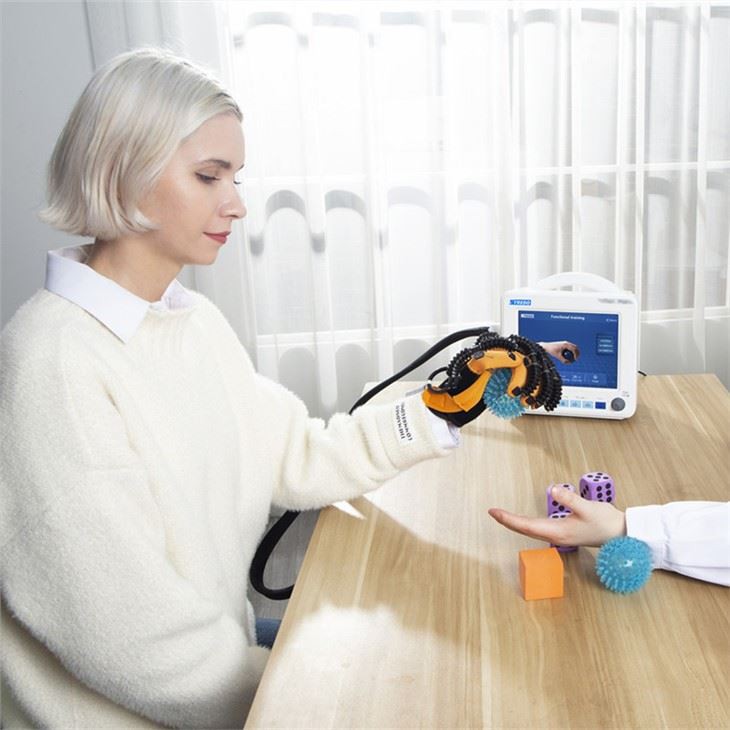
Smart Glove Rehabilitation is a great example of a product that uses exoskeleton technology for rehabilitation. It's designed to help patients with hand injuries or neurological conditions improve their hand function through a series of exercises and activities. The glove provides adjustable support and feedback to help the user strengthen their hand muscles and improve their coordination.
Another application is in assistive technology for people with disabilities. Exoskeleton hands can help people with conditions like cerebral palsy, multiple sclerosis, or spinal cord injuries perform daily tasks that would otherwise be difficult or impossible.
Stroke Recovery Exoskeleton Gloves are specifically designed to help stroke survivors regain their hand function. These gloves provide targeted support and assistance to the hand muscles, helping the user to perform tasks like grasping, holding, and releasing objects.
Exoskeleton hands can also be used in industrial settings. Workers who perform repetitive tasks with their hands, like assembly line workers or surgeons, can benefit from using exoskeleton hands to reduce the risk of injury and fatigue.
Hand Finger Exercise Equipment is another product that can be used in industrial settings. It's designed to help workers strengthen their hand muscles and improve their dexterity, which can help to prevent injuries and improve productivity.
In conclusion, exoskeleton hands are a really amazing technology that can provide a lot of benefits to users. They support the hand muscles through assistive force, feedback, and adjustable support, and they can be used in a variety of applications, including rehabilitation, assistive technology, and industrial settings.
If you're interested in learning more about exoskeleton hands or if you're looking for a solution to support your hand muscles, I'd love to chat with you. Whether you're a healthcare provider, a patient, or an industrial worker, we have a range of products that can meet your needs. So, don't hesitate to reach out and start a conversation about how we can work together to improve hand function and quality of life.
References
- Various research studies on exoskeleton technology and hand muscle support
- Product documentation for Smart Glove Rehabilitation, Stroke Recovery Exoskeleton Gloves, and Hand Finger Exercise Equipment