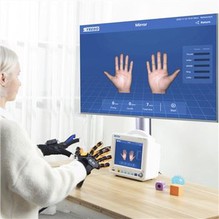
Exoskeleton gloves, often called robotic gloves or powered hand exoskeletons, are wearable devices that support or drive movement of the fingers and thumb. In rehabilitation, they are used to help people who have lost part of their hand function after a stroke, a spinal cord injury, or another neurological or orthopedic condition practice the repeated, task-oriented movements that modern therapy programs are built around. Similar technology is also used to assist grip in industrial settings, but this article focuses on rehabilitation use: how the technology works, what the research says, and how to evaluate devices objectively.
How Exoskeleton Glove Technology Works
Actuation: how the glove moves the fingers
The actuator is the part of the glove that generates movement. Three approaches are common in rehabilitation devices:
- Soft pneumatic actuators. Flexible chambers or bellows sit along the fingers and bend as they are inflated, gently opening or closing the hand. Because the structure is soft and compliant, it adapts to different hand shapes and is generally well tolerated by patients with spasticity or sensitive joints.
- Cable- or tendon-driven systems. Small electric motors pull cables routed along the fingers, mimicking the way tendons move the hand. These systems can deliver precise, individually controlled finger movements.
- Rigid linkage mechanisms. Motor-driven mechanical linkages guide each joint through a defined trajectory. They offer accurate control but add weight and usually require more careful fitting.
Some devices are unpowered and use springs or elastic elements to assist extension. These are simpler, but they cannot actively drive a movement the user cannot initiate.
Sensing and control
To coordinate assistance with the user, gloves rely on sensors. Joint-angle and position sensors track finger movement; force or pressure sensors monitor grip interaction. Some systems add surface electromyography (EMG) electrodes that detect the user's muscle activity, allowing the device to respond to the wearer's own movement intention. Control strategies range from simple pre-programmed exercise cycles to assist-as-needed control, in which the device contributes only the support the user cannot provide alone.
Training modes
Most rehabilitation gloves offer several exercise modes, because different stages of recovery call for different kinds of practice:
- Passive training: the device moves the relaxed hand through its range of motion, which is useful early on, when voluntary movement is limited.
- Active-assisted training: the user attempts the movement and the glove completes it, supporting repetitive, high-dosage practice.
- Active or resisted training: the user moves against light resistance to build strength and control.
- Bilateral or mirror training: the unaffected hand leads and the device mirrors the movement on the affected side.
- Task-oriented and gamified exercises: interactive games and simulated daily activities that keep repetition counts high and engagement up.
Where Exoskeleton Gloves Fit in Recovery
Hand recovery after a neurological injury is usually described in broad stages, and the role of a glove changes across them. In the early and subacute phase, when the hand may be flaccid or very weak, passive mobilization and assisted movement help maintain joint range and introduce repeated movement patterns. As voluntary control returns, active-assisted and task-oriented modes let patients practice grasping, releasing, and manipulating objects at a repetition volume that would be hard to sustain in manual therapy alone. In the chronic phase and at home, compact devices can support continued practice between supervised therapy sessions.
What does the evidence say? Systematic reviews of robot-assisted upper-limb training after stroke report that this kind of training can increase practice intensity and is associated with modest improvements in motor control and muscle strength of the trained limb, while effects on everyday activities are less consistent and benefits appear specific to the joints actually trained (Veerbeek et al., 2017; Mehrholz et al., 2018; Kwakkel et al., 2008). Research on hand-specific soft robotic gloves suggests they are feasible for assisted grasping and home-based practice, but the evidence base is still developing (Polygerinos et al., 2015). In short, research suggests exoskeleton gloves may help as one component of a broader rehabilitation program; results vary from person to person, and a rehabilitation physician or therapist should decide whether - and at which stage - such a device belongs in an individual treatment plan.
How to Evaluate Options: A Practical Checklist
Whether you are equipping a clinic, a hospital department, or a distribution portfolio, an objective comparison matters more than any ranking list. Five areas are worth examining with every candidate device.
1. Regulatory status and quality management
Ask for the market-specific regulatory status and supporting documents for the exact model under review. For the United States, distinguish FDA establishment registration and device listing from product-level 510(k) clearance or PMA approval. For the European Union, review applicable CE marking and MDR documentation. Also ask about the manufacturer's medical-device quality management system. Treat current, model-specific records—not marketing shorthand—as the deciding evidence.
2. Clinical evidence
Look for peer-reviewed studies on the specific device or, at minimum, on the same device class, with verifiable citations such as a DOI or PubMed entry. Check whether the studied population matches your intended users - for example, subacute stroke versus chronic hand impairment - and be cautious with effectiveness claims that cite no source you can verify.
3. Fitting, training, and support
Practical questions strongly influence day-to-day value: Which hand sizes and which handedness does the glove cover? How long does fitting take? What therapist training, onboarding materials, and clinical support does the manufacturer provide? Are software updates, spare parts, and responsive technical service available in your region?
4. Hygiene and durability
In shared clinical use, ask how the glove and its contact surfaces are cleaned between patients, which components are single-patient items, and what the expected service life is under daily use.
5. Lifecycle planning and operational value
Look beyond the device alone and map the resources required across its service life: consumables and wear parts, software access, warranty and service coverage, fitting time, staff training, and regional technical support. A transparent lifecycle plan helps clinical and distribution teams compare operational value and plan reliable implementation.
The Syrebo Approach
Syrebo (Shanghai Siyi Intelligent Technology Co., Ltd.) develops soft robotic rehabilitation devices for clinic and home use, including hand rehabilitation gloves built on pneumatic soft actuators with passive, assisted, and interactive training modes. You can explore the product range on our products page and read summaries of published research on our clinical evidence page.
If you are evaluating exoskeleton gloves for a clinic, hospital, or distribution partnership, our team can provide detailed specifications, documentation, and fitting guidance - contact us to start the conversation.
References
- Mehrholz J, Pohl M, Platz T, Kugler J, Elsner B. Electromechanical and robot-assisted arm training for improving activities of daily living, arm function, and arm muscle strength after stroke. Cochrane Database of Systematic Reviews. 2018;(9):CD006876. https://doi.org/10.1002/14651858.CD006876.pub5
- Veerbeek JM, Langbroek-Amersfoort AC, van Wegen EEH, Meskers CGM, Kwakkel G. Effects of robot-assisted therapy for the upper limb after stroke: a systematic review and meta-analysis. Neurorehabilitation and Neural Repair. 2017;31(2):107-121. https://doi.org/10.1177/1545968316666957
- Kwakkel G, Kollen BJ, Krebs HI. Effects of robot-assisted therapy on upper limb recovery after stroke: a systematic review. Neurorehabilitation and Neural Repair. 2008;22(2):111-121. https://doi.org/10.1177/1545968307305457
- Polygerinos P, Wang Z, Galloway KC, Wood RJ, Walsh CJ. Soft robotic glove for combined assistance and at-home rehabilitation. Robotics and Autonomous Systems. 2015;73:135-143. https://doi.org/10.1016/j.robot.2014.08.014