| Study type | Narrative review (summarises existing evidence rather than running a new experiment) |
| Focus | Hand rehabilitation in children and adolescents after brain damage |
| Journal | Slovenska Pediatrija, 31(4):180–187, 2024 |
| Key message | Hand recovery depends chiefly on corticospinal tract integrity and neuroplasticity; early, intensive, task-oriented rehabilitation — combined with robot-assisted training — can enhance it |
When a child or teenager experiences brain damage — for example from a stroke, an injury, or a condition affecting the developing brain — the hand is often one of the hardest functions to recover. This 2024 paper is a narrative review: rather than testing one new treatment, its authors gather and summarise the existing evidence on how young people regain hand function and which therapies help. Their central conclusion is that recovery depends most of all on two things: how intact the corticospinal tract is (the main nerve pathway carrying movement signals from the brain to the hand) and the young brain's capacity for neuroplasticity (its ability to reorganise and form new connections). The encouraging message for families is that early, intensive, task-focused rehabilitation — and, where appropriate, robot-assisted training — can support that recovery.
Children and adolescents are not simply small adults. Their brains are still developing, which can offer a greater potential for reorganisation — but it also means rehabilitation has to fit a growing body, changing abilities, and the demands of school and play. Because the research on paediatric hand rehabilitation is spread across many small studies and different techniques, families and clinicians can struggle to see the whole picture. A review like this one pulls those threads together, explaining how recovery tends to unfold and which of the many available approaches have supporting evidence, so that care can be planned around the individual child.
The authors describe hand recovery after brain damage as typically moving through stages: from an early flaccid phase (little muscle tone or movement), through a spastic phase (increased, sometimes stiff muscle tone), and toward the return of more selective voluntary motor control. Understanding where a child sits along that path helps match the right therapy at the right time. The review surveys a broad toolkit of interventions that clinicians may draw on:
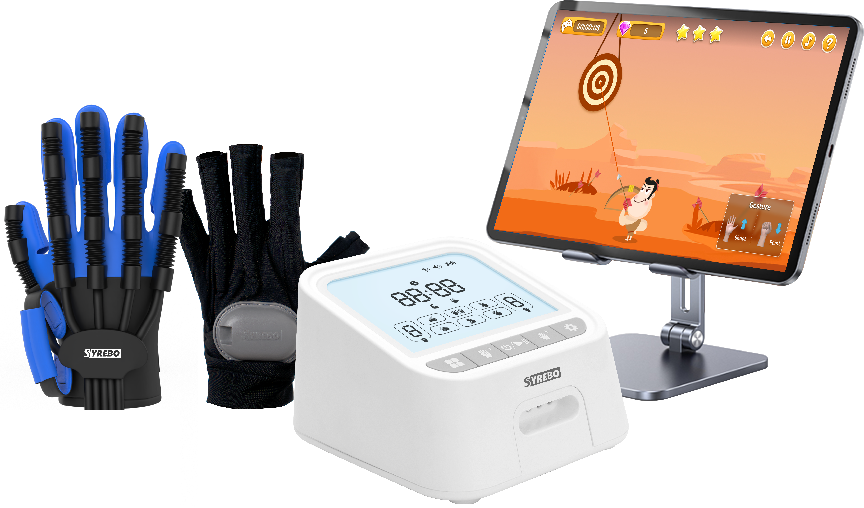
For parents, the practical thread running through the review is that consistent, meaningful practice matters — hand skills improve when they are used repeatedly in ways that are relevant to the child, and when rehabilitation begins early and stays intensive. Robot-assisted training can help by adding the volume and repetition of practice that recovery needs, including as a complement to therapist-led sessions. Syrebo's home rehabilitation devices are designed to support this kind of regular, high-repetition hand practice, while clinical rehabilitation systems support supervised programmes; you can see the range of hand-rehabilitation options on the Syrebo products page. Because every child's brain injury and stage of recovery are different — and because children have specific safety, sizing, and developmental needs — any therapy or device for a child must be selected and supervised by a qualified paediatric rehabilitation professional.
Bregant, T., Šinkovec, P., & Pavlinič, R. (2024). Rehabilitation of the hand in children and adolescents after brain damage. Slovenska Pediatrija, 31(4), 180–187. DOI: 10.38031/slovpediatr-2024-4-02
According to this 2024 review, recovery is possible and depends mainly on how intact the corticospinal tract is and on the young brain's neuroplasticity. Early, intensive, task-oriented rehabilitation can support recovery. Outcomes vary from child to child, so care should be guided by a paediatric rehabilitation team.
The review surveys intensive task-oriented training, constraint-induced movement therapy (CIMT), robot-assisted rehabilitation, non-invasive brain stimulation (tDCS and rTMS), botulinum toxin for spasticity, sensory and music-based interventions, and occupational therapy. Which combination suits a particular child is a clinical decision.
The review describes recovery moving through stages — from a flaccid phase, through a spastic phase, toward the return of voluntary motor control. Knowing the stage helps clinicians choose the most appropriate therapy at each point.
This article summarizes published research for educational purposes. It is not medical advice and does not guarantee individual outcomes. Rehabilitation for children and adolescents should always be planned and supervised by a qualified paediatric healthcare professional, and needs vary from child to child.