| Study type | Randomized controlled trial (RCT) |
| Participants | 60 stroke patients with hand dysfunction, randomized into two groups |
| Journal | Journal of New Medicine, 55(6):397–402, 2024 |
| Key result | Adding innovative (robotic) mirror therapy produced significantly greater gains in upper-limb function and daily-living ability than traditional mirror therapy |
Mirror therapy is a well-established stroke-rehabilitation technique: a mirror is positioned so that the reflection of the unaffected arm appears in place of the affected one, "tricking" the brain into practising movement. This 2024 randomized controlled trial (RCT) asked a focused question — does delivering mirror therapy in an innovative, robot-assisted way work better than the traditional mirror-box approach? Both groups improved. But the group whose mirror therapy was delivered with the SY-HR08 hand rehabilitation robot, on top of conventional rehabilitation, improved significantly more in upper-limb function and in activities of daily living than the group that received traditional mirror therapy on top of the same conventional rehabilitation. Because an RCT assigns patients to groups at random, it is the strongest everyday design for testing whether one approach genuinely outperforms another.
After a stroke, regaining arm and hand function is often slow and difficult, and rehabilitation programmes look for ways to make practice more engaging and more repeatable. Traditional mirror therapy is low-cost and widely used, but it relies on a simple mirror and the patient's own effort. Robot-assisted mirror therapy aims to add structured, guided, high-repetition movement to the same neurological principle. The researchers set out to test — under controlled conditions rather than by assumption — whether this innovative delivery adds measurable benefit over the traditional method.
| Design | Randomized controlled trial (RCT) |
| Sample size | 60 stroke patients with hand dysfunction, randomized into two groups |
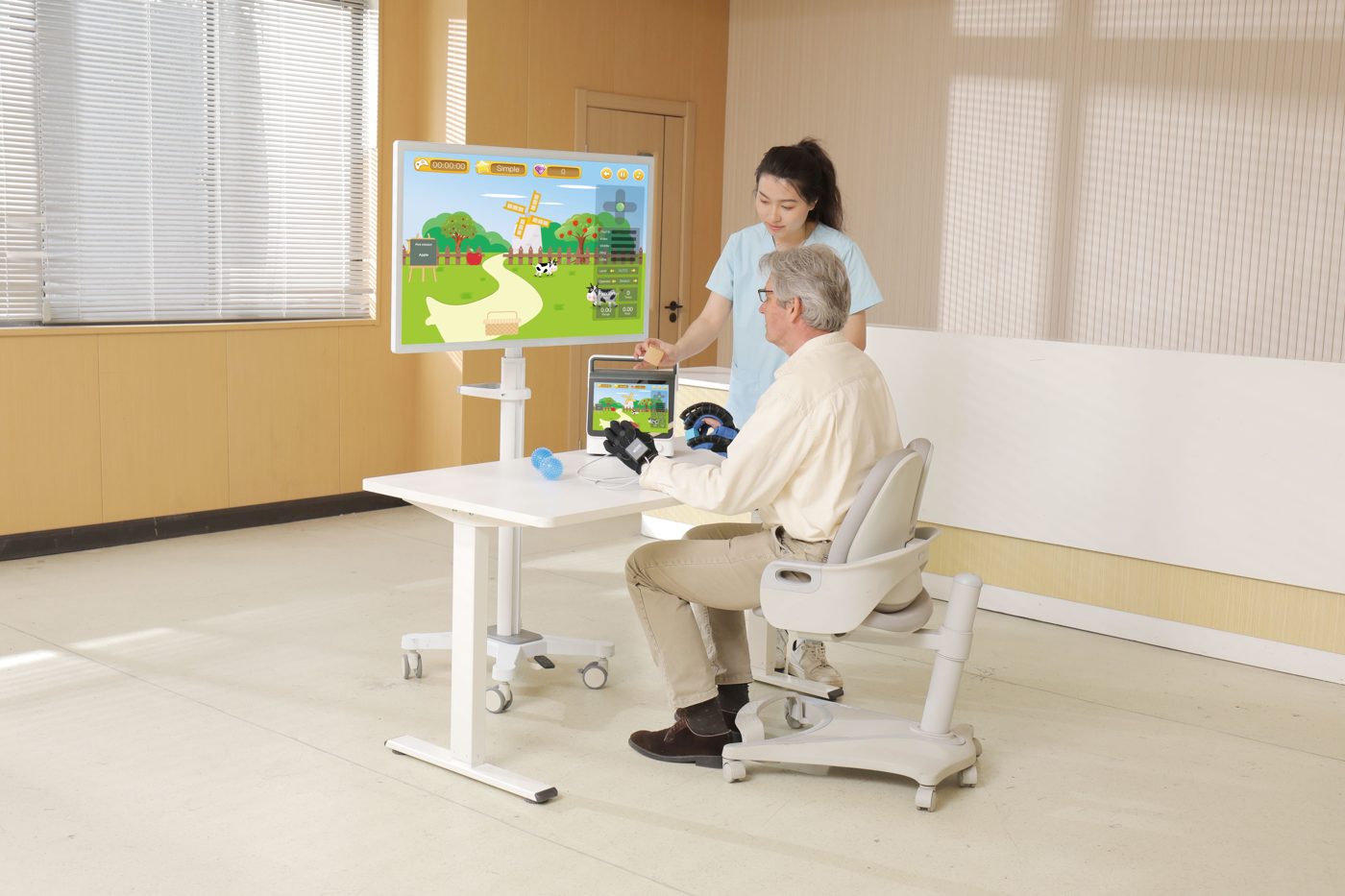
| Intervention group | Conventional rehabilitation plus innovative mirror therapy delivered with the SY-HR08 hand rehabilitation robot |
| Control group | Conventional rehabilitation plus traditional mirror therapy |
| Dose / duration | 5 sessions per week for 4 weeks |
| Outcomes assessed | Measures of upper-limb function and daily-living ability (ADL) |
Both groups received the same conventional rehabilitation base; the only difference under test was how the mirror therapy was delivered — robot-assisted versus traditional.
The study adds controlled evidence that how mirror therapy is delivered matters: pairing the established neurological principle with a hand rehabilitation robot appears to amplify recovery of arm function and everyday independence beyond the traditional mirror alone. Importantly, this was a comparison of two active therapies — both worked — so the finding is best read as "robot-assisted delivery added measurable benefit," not as a cure or a guarantee. The SY-HR08 used in the study is a Syrebo hand rehabilitation robot; Syrebo's clinical rehabilitation systems support supervised, high-intensity programmes of exactly this kind, while home rehabilitation devices help patients sustain practice between clinic sessions. Recovery varies from person to person, and the right device and programme should be chosen and guided by a rehabilitation professional.
Chen, T., Liu, S. X., Chen, X. L., Mao, L., Li, D. B., & Gan, L. Y. (2024). Rehabilitation effect of innovative mirror therapy on upper limb impairment in stroke patients. Journal of New Medicine, 55(6), 397–402. DOI: 10.3969/j.issn.0253-9802.2024.06.001
In this 2024 randomized controlled trial of 60 stroke patients with hand dysfunction, both groups improved, but the group that received innovative mirror therapy delivered with the SY-HR08 hand rehabilitation robot (added to conventional rehabilitation) improved significantly more in upper-limb function and activities of daily living than the group that received traditional mirror therapy. Results vary by individual, and rehabilitation should be guided by your medical team.
Traditional mirror therapy uses a simple mirror so the reflection of the unaffected arm stands in for the affected one. The innovative version in this study delivered the same principle with a hand rehabilitation robot (the SY-HR08), adding structured, guided, repeatable movement. In the trial, both approaches were added on top of the same conventional rehabilitation.
Participants trained 5 sessions per week for 4 weeks.
It comes from a randomized controlled trial (RCT) — the strongest everyday design for testing whether one treatment outperforms another. That said, the sample was modest (60 patients) and it compared two active therapies rather than a treatment against nothing, so it is a meaningful signal rather than a final word. Larger trials continue to build the wider picture.
The SY-HR08 is a Syrebo hand rehabilitation robot. In this study it was used to deliver the innovative mirror-therapy programme. Whether any particular device suits a given patient depends on the individual and should be decided with a rehabilitation professional.
Tell us about the hand and stage of recovery, and we'll recommend the right approach — no obligation.
Get expert adviceThis article summarizes published research for educational purposes. It is not medical advice and does not guarantee individual outcomes. Always consult a qualified healthcare professional about stroke rehabilitation.