| Study type | Randomized controlled trial (RCT) |
| Participants | 30 subacute stroke patients (9 male, 21 female) |
| Journal | SPORT TK-EuroAmerican Journal of Sport Sciences, 2025 |
| Key result | Adding a robotic glove produced significantly greater grip strength and motor-function gains vs. conventional therapy alone |
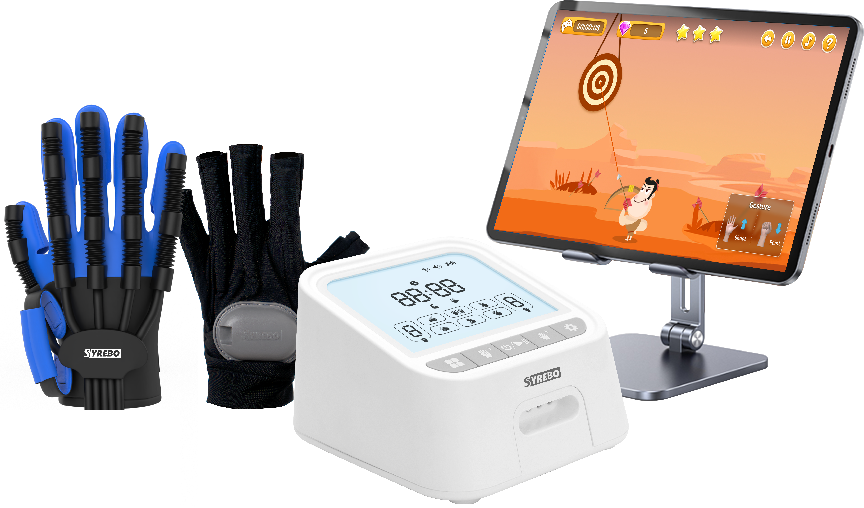
Researchers wanted to know a simple, practical question: if a stroke patient adds a robotic rehabilitation glove to their normal physiotherapy, do they actually recover more hand function? In this 2025 randomized controlled trial, the answer was yes. The group that trained with a Syrebo robotic glove in addition to conventional therapy improved their grip strength and overall hand motor function significantly more than the group that did conventional therapy alone. Because it was a randomized controlled trial — the strongest everyday study design for testing whether a treatment works — the result carries real weight.
After a stroke, the hand is often one of the hardest parts of the body to recover, and conventional physiotherapy alone frequently plateaus. Robotic training gloves are designed to assist hand movements by providing resistance, support, or guidance — and when combined with mirror-mode training, they may help drive the high-repetition, task-focused practice that motor recovery needs. The researchers set out to test whether that theory holds up in a controlled setting.
The study adds controlled evidence to a growing picture: robotic gloves are not a replacement for physiotherapy, but a way to amplify it — delivering the training dose and repetition that a therapist alone cannot always provide, and extending practice beyond the clinic. Syrebo's home rehabilitation gloves are built for exactly this role, so that patients can keep up the training volume between clinic sessions, while clinical systems support supervised, high-intensity programs. As always, the right device and program depend on the individual and should be guided by a rehabilitation professional.
Abd Elhady, A. S., Ahmed, G. M., Hassan, A., Ibrahim, S. M., & Abdelmageed, S. M. (2025). Efficacy of robotic training gloves in improving hand function and movement in stroke patients. SPORT TK-EuroAmerican Journal of Sport Sciences, 14, Article 40. Online ISSN 2340-8812.
In this 2025 randomized controlled trial, stroke patients who added robotic-glove training to conventional physiotherapy gained significantly more grip strength and motor function than those doing conventional therapy alone. Results vary by individual, and rehabilitation should be guided by your medical team.
A robotic glove assists, resists, or guides hand movements and enables high-repetition, mirror-mode training. It is designed to complement — not replace — a physiotherapist, by increasing the amount and consistency of practice.
Participants trained 5 sessions per week for 4 weeks, with robotic sessions lasting 30 minutes each.
This article summarizes published research for educational purposes. It is not medical advice and does not guarantee individual outcomes. Always consult a qualified healthcare professional about stroke rehabilitation.