
| Study type | Case report (single patient, n = 1) — the weakest evidence tier |
| Patient | A 66-year-old with a middle cerebral artery (MCA) infarct |
| Journal | Cureus 16(4): e59314, April 29, 2024 |
| Reported result | After 6 weeks of neurorehabilitation plus Syrebo glove training, the patient improved on all five measures recorded |
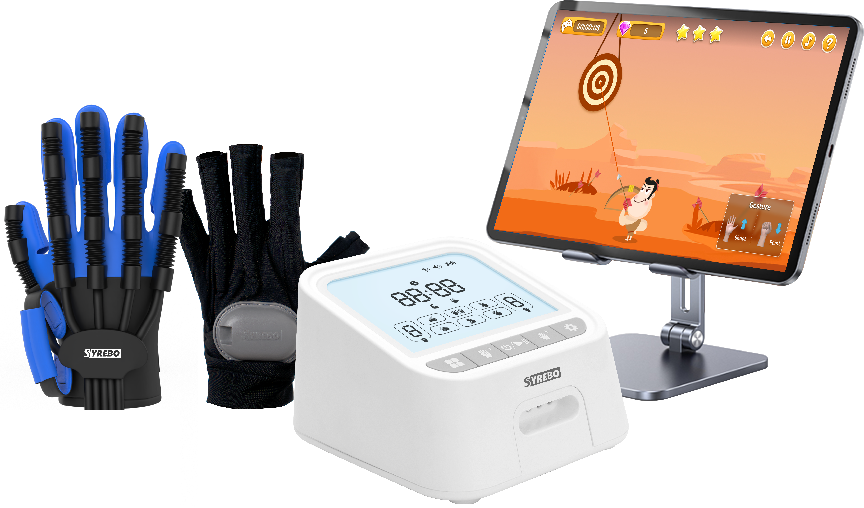
This is a case report: a detailed description of the rehabilitation of a single patient — a 66-year-old who had suffered a middle cerebral artery (MCA) infarct, a common type of stroke. Over 6 weeks, the patient followed a neurorehabilitation program that included training with a Syrebo rehabilitation glove (30 repetitions × 3 sets). By the end, the clinicians recorded improvements across every measure they tracked, from level of consciousness to hand and mobility function. It is important to be clear about what this kind of study can and cannot tell us: because it follows just one patient with no comparison group, a case report describes what happened but cannot prove that the glove caused the improvement, or that other patients would respond the same way. It is an early, encouraging signal — not proof.
After a stroke caused by an MCA infarct, regaining hand and arm function is often one of the slowest and most difficult parts of recovery. Rehabilitation gloves are designed to assist hand movements and deliver the high-repetition, task-focused practice that motor recovery depends on. Case reports like this one are how promising approaches first get documented in the medical literature: they describe a real patient's course in detail, generate ideas worth testing, and point toward the larger, controlled studies needed to confirm whether the effect is real and general.
| Element | Detail |
|---|---|
| Design | Case report (single patient, n = 1) |
| Patient | A 66-year-old with a middle cerebral artery (MCA) infarct |
| Intervention | 6 weeks of neurorehabilitation plus Syrebo glove training |
| Glove training dose | 30 repetitions × 3 sets |
| Outcome measures | Glasgow Coma Scale; Tone grading; Functional independence; ICU mobility; Brunnstrom |
| Measure | Before | After |
|---|---|---|
| Glasgow Coma Scale | 11/15 | 13/15 |
| Tone grading | 1+ | 2+ |
| Functional independence | 1/7 | 6/7 |
| ICU mobility | 1/10 | 7/10 |
| Brunnstrom | 1/7 | 3/7 |
These are the observed values for one patient, recorded before and after the 6-week program. As a single case with no control group, the numbers describe this patient's course only — they do not establish that the glove caused the change, and they cannot be generalized.
The authors concluded that Syrebo glove rehabilitation showed promising results in promoting motor recovery, improving hand function, and enhancing functional independence for this patient. Read honestly, that is a hopeful early observation, not a proof of effectiveness: a single case cannot show cause and effect, and larger controlled trials are needed before any firm conclusion. Within that limit, the case fits a broader idea that rehabilitation gloves may amplify conventional therapy — helping deliver training volume and repetition alongside a clinician's program. Syrebo's home rehabilitation gloves are built for that supporting role, helping patients keep up practice between clinic sessions, while clinical rehabilitation systems support supervised programs. The right device and program always depend on the individual and should be guided by a rehabilitation professional.
Sharma, V. S., Sharath, H., & Sasun, A. R. (2024). Effectiveness of Syrebo's Glove Rehabilitation Program in a Patient With Middle Cerebral Artery Infarct: A Case Report. Cureus, 16(4), e59314. Published April 29, 2024. DOI: 10.7759/cureus.59314
In this 2024 case report, a 66-year-old patient with a middle cerebral artery infarct improved on every measure recorded — including functional independence (1/7 → 6/7) and Brunnstrom stage (1/7 → 3/7) — after 6 weeks of neurorehabilitation plus Syrebo glove training. Because this is a single patient with no comparison group, it cannot prove the glove caused the improvement. Results vary by individual, and rehabilitation should be guided by your medical team.
This is a case report — a description of one patient (n = 1). It is the weakest tier of clinical evidence: it can document what happened but cannot establish cause and effect or show that other patients would respond the same way. Larger, controlled trials are needed to confirm whether the effect is real and general.
The patient completed 30 repetitions × 3 sets of Syrebo glove training as part of a 6-week neurorehabilitation program.
A middle cerebral artery (MCA) infarct is a common type of stroke in which blood flow through the middle cerebral artery is blocked. It often affects movement and function on one side of the body, including the hand and arm.
Tell us about the hand and stage of recovery, and we'll recommend the right approach — no obligation.
Get expert adviceThis article summarizes a published single-patient case report for educational purposes. A case report cannot prove cause and effect or be generalized, results differ between individuals, and this is not medical advice. Always consult a qualified healthcare professional about stroke rehabilitation.