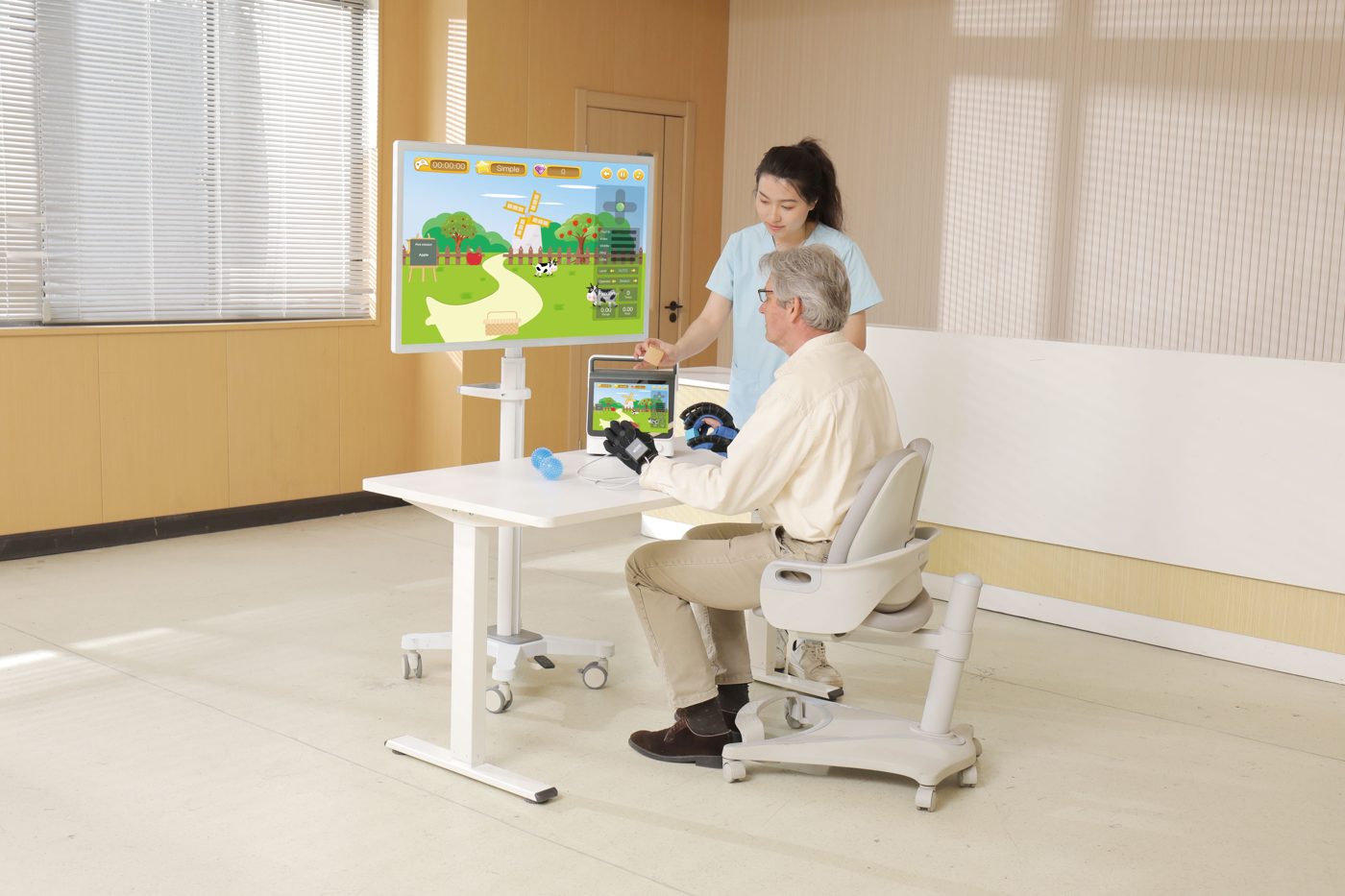
| Study type | Case report (single patient) |
| Patient | 66-year-old with a middle cerebral artery (MCA) infarct |
| Journal | Cureus 16(4):e59314, 2024 |
| Key result | After 6 weeks of neurorehabilitation with a Syrebo glove, the patient showed gains across every functional measure recorded — promising, but from one case only |
This is a case report: the detailed, real-world tracking of a single patient rather than a controlled trial. A case report sits lower on the evidence ladder than a randomized controlled trial (RCT) — it cannot prove that a treatment caused an outcome, and it cannot be generalized to other patients — but it offers a valuable, close-up look at how a real clinical course unfolds. Here, doctors followed a 66-year-old stroke patient through a six-week rehabilitation program that included the Syrebo rehabilitation glove, and recorded steady improvement across consciousness, hand tone, mobility, and functional independence.
A stroke caused by a blockage in the middle cerebral artery (MCA) commonly leaves the arm and hand weak, and recovery of hand function is often slow and difficult. The clinical team documented this patient's journey to illustrate how a structured neurorehabilitation program — combined with robotic-glove hand training — played out in practice, and to share the measurable changes they observed along the way.
| Measure | Before | After |
|---|---|---|
| Glasgow Coma Scale | 11/15 | 13/15 |
| Tone grading | 1+ | 2+ |
| Functional independence | 1/7 | 6/7 |
| ICU mobility | 1/10 | 7/10 |
| Brunnstrom stage | 1/7 | 3/7 |
These are the values recorded for one patient over the program. Because this is a single case with no control group, the numbers describe this individual's course — they cannot be attributed to the glove alone.
The authors concluded that Syrebo glove rehabilitation showed promising results in promoting motor recovery, improving hand function, and enhancing functional independence for this patient. As a case report, it does not prove that the glove caused the improvement, and a single patient's experience should not be assumed to repeat in others. What it does offer is a real clinical example of how robotic-glove training can fit inside a broader neurorehabilitation program. Syrebo's home rehabilitation gloves are built to support the repetitive hand practice such programs rely on, while clinical rehabilitation systems support supervised, structured recovery like the one described here; product options such as the stroke hand-therapy robotic glove are designed for exactly this setting. Outcomes vary from person to person, and any rehabilitation program should be chosen and guided by a qualified professional.
Sharma, V. S., Sharath, H., & Sasun, A. R. (2024). Effectiveness of Syrebo's Glove Rehabilitation Program in a Patient With MCA Infarct: A Case Report. Cureus, 16(4), e59314. https://doi.org/10.7759/cureus.59314
No. This is a case report describing a single 66-year-old patient, so it cannot prove cause and effect or be generalized to other people. It documents promising improvements for one individual and should be read alongside stronger evidence such as randomized controlled trials. Always follow the guidance of your medical team.
Over six weeks the patient's recorded scores moved from 11/15 to 13/15 on the Glasgow Coma Scale, 1/7 to 6/7 on functional independence, 1/10 to 7/10 on ICU mobility, and 1/7 to 3/7 on the Brunnstrom stage, with tone grading changing from 1+ to 2+. Results like these vary from person to person.
Hand training with the Syrebo glove was given as 30 repetitions across 3 sets per session, within a six-week structured neurorehabilitation program.
This article summarizes a published case report for educational purposes. A single case cannot be generalized, results differ between individuals, and this is not medical advice. Always consult a qualified healthcare professional and follow their guidance about stroke rehabilitation.