Stroke Center
Home>Stroke Center>Content
Home>Stroke Center>Content
After a stroke, families and survivors quickly discover that motor recovery is not a single step from "paralyzed" to "recovered" — it moves through a predictable sequence of stages. The most widely used map of that sequence is the Brunnstrom stages of stroke recovery: six recognizable stages that describe how muscle tone, reflexes, and voluntary movement change as the brain reorganizes. Understanding which stage a survivor is in helps everyone — patient, family, and therapist — choose the right kind of exercise and set realistic expectations.
This guide explains all six Brunnstrom stages in plain language, provides a quick-reference chart, and shows how hand rehabilitation is matched to each stage. It complements our overview of the 6 stages of stroke recovery and the targeted training for each stage and our stroke recovery timeline. Recovery is highly individual: the stages are a framework, not a schedule, and nothing here replaces the guidance of your medical team.
The framework was developed in the 1960s by Signe Brunnstrom, a Swedish physical therapist, based on her observations of how motor control returns after stroke. Her key insight was that recovery is not random: after the initial paralysis, muscle tone and abnormal movement patterns (called synergies) emerge in a consistent order, then gradually give way to isolated, voluntary control. Clinicians still use the Brunnstrom approach both as a way to assess where a survivor is in their recovery and as a guide to what kind of therapy is appropriate next.
You may see the process described as "6 stages," "7 stages," or occasionally "3 stages" of stroke recovery. These are not contradictions — they describe the same journey at different resolutions. Brunnstrom's classic model has six stages. Some sources add a seventh stage to represent the full return of normal, coordinated movement, which is why "7 stages of stroke recovery" also appears. Simplified "3 stages" versions group them into early (flaccid), middle (spastic), and late (recovery) phases. This article uses the standard six-stage model. Recovery varies from person to person, and any exercise plan should be guided by a rehabilitation professional.
The chart below summarizes each stage by its defining feature — muscle tone and synergy pattern — what it means for movement, and the therapy focus that typically fits. Use it as a quick reference; the sections that follow explain how hand rehabilitation applies to each stage.
| Stage | Muscle tone & synergy | What it means for movement | Typical therapy focus |
|---|---|---|---|
| 1 — Flaccidity | No muscle tone; the limb is limp. No voluntary movement, no reflex activity or synergies yet. | The affected arm and hand cannot move at all. This stage usually appears immediately after the stroke. | Passive movement to preserve joint range and prevent stiffness; positioning; sensory stimulation to signal the brain. |
| 2 — Spasticity appears | Muscle tone begins to return as spasticity (tightness). Basic limb synergies start to emerge, often as involuntary "associated reactions." | The first minimal, involuntary movements appear, usually locked into fixed synergy patterns rather than controlled by the person. | Continued passive/assisted movement; gentle stretching; beginning to encourage any voluntary effort; managing early spasticity. |
| 3 — Spasticity increases | Spasticity reaches its peak — muscle tightness is most pronounced. | The survivor gains some voluntary control, but movement is still confined to the abnormal synergy patterns (e.g., the whole arm flexes together). | Assisted, repetitive movement within and slightly beyond synergies; spasticity management; mirror therapy and electrical stimulation are commonly introduced. |
| 4 — Spasticity decreases | Spasticity begins to decline. | Some movement combinations that break out of the fixed synergy patterns become possible — more selective, isolated control starts to appear. | Active-assisted and active practice of out-of-synergy movements; growing emphasis on task-oriented and repetitive training. |
| 5 — Complex movement combinations | Spasticity continues to decrease; synergy patterns lose their grip on movement. | More complex, independent movements become possible, with increasingly isolated control of individual joints and fingers. | Task-oriented training on real activities; strengthening; refining coordination and fine-motor hand control. |
| 6 — Spasticity disappears | Spasticity is largely gone; muscle tone approaches normal. | Isolated joint movements and coordinated, near-normal movement are possible; fine hand and finger control returns. | Advanced coordination and dexterity practice; endurance; returning to daily activities, work, and hobbies. |
Note: some models add a Stage 7 — the full return of normal motor function — which is why you may see "7 stages of stroke recovery." Not every survivor progresses through all six stages, and progress can stall or vary from person to person; the sequence is a guide, not a guarantee.
A formal Brunnstrom assessment is done by a physiotherapist or occupational therapist, who observes muscle tone, reflexes, and how much voluntary and isolated movement is present. As a rough, at-home orientation only, families sometimes notice these signposts for the hand and arm:
This is only a general orientation. An accurate assessment — and a safe exercise plan — should come from a qualified clinician, and progress varies from person to person.
The reason the Brunnstrom stages matter in practice is that the right exercise changes as recovery progresses. Pushing a flaccid hand to "grip harder" is pointless; leaving a stage-5 hand on passive stretches wastes recovery potential. Here is how hand rehabilitation is generally matched to each phase — always under the guidance of a rehabilitation professional.
When the hand cannot move on its own, the goals are to keep the joints mobile, prevent stiffness and swelling, and feed sensory input back to the brain to support rewiring. This is done through passive range-of-motion — a therapist or family member gently moving the fingers, wrist, and arm — and, where available, electrical stimulation to help wake dormant muscles.
Because these repetitions need to happen many times a day, rehabilitation departments increasingly use soft robotic gloves running in passive mode to deliver consistent finger flexion and extension when a survivor has no active movement yet. Devices such as the Syrebo C10 hand rehabilitation glove are designed for exactly this earliest, hardest stage, and pair naturally with clinic-based electrical stimulation (TENS) devices. This is where powered robotic gloves have a clear advantage over spring-loaded gloves, which need the hand to supply some force of its own.
As voluntary movement returns — but is still tangled in synergy patterns and limited by spasticity — the focus shifts to assisted, high-repetition practice that helps the hand move through natural grasp-and-release, plus techniques that engage the brain. Mirror therapy, in which the reflection of the healthy hand "tricks" the brain into activating the affected side, is commonly introduced here, and managing spasticity (through stretching, positioning, and medical treatment when needed) becomes important.
Robotic gloves are well suited to this stage because they can assist a weak, tight hand through a full, correct movement it could not complete alone — and many combine both ideas at once. A glove with a mirror-training mode, such as the lighter Syrebo C11 soft robotic glove, lets the healthy hand lead while the affected hand follows, delivering hundreds of guided repetitions per day at home between therapy sessions.
Once the hand can make more isolated, out-of-synergy movements, the priority becomes task-oriented training — practicing real activities such as grasping a cup, buttoning a shirt, or manipulating small objects — to convert raw movement into everyday function. Strengthening, coordination, and dexterity work round out this phase.
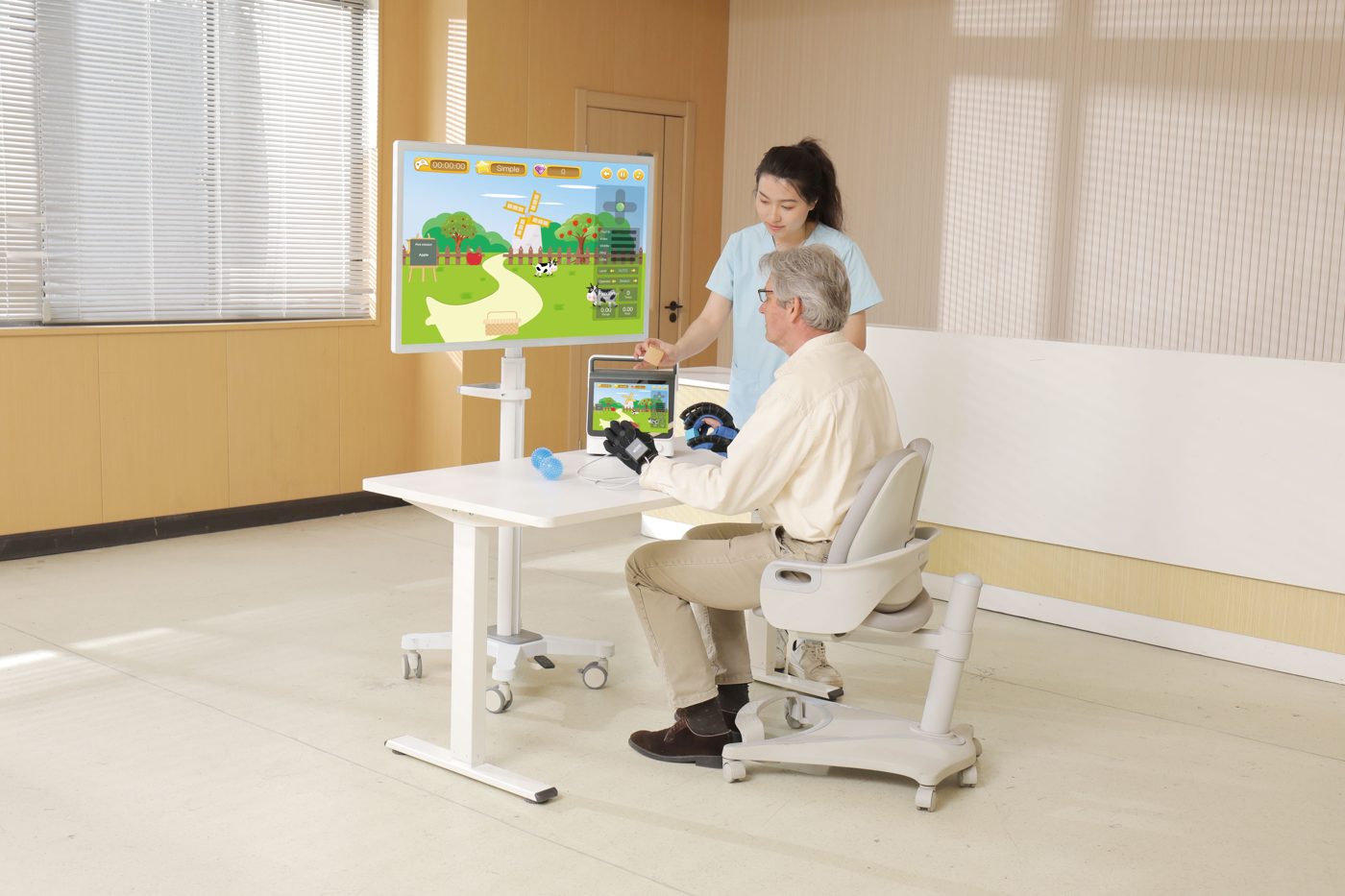
The hardest problem in later-stage rehab is not capability but motivation: keeping up the volume of practice month after month. Devices that make training engaging help here; for example, the Syrebo E12E hand rehabilitation robot combines guided hand training with interactive, game-based tasks. For clinics building programs across all six stages, our clinic rehabilitation systems and home rehabilitation equipment are designed to hand off seamlessly from hospital to home so the training dose never drops to zero.
The Brunnstrom stages are a six-stage model describing how motor control returns after a stroke: (1) flaccidity — no movement; (2) spasticity appears — minimal, involuntary movement in synergy patterns; (3) spasticity increases — voluntary movement within synergies; (4) spasticity decreases — some movement breaks out of synergy patterns; (5) complex movement combinations — more isolated, independent control; and (6) spasticity disappears — near-normal, coordinated movement. They were developed by physical therapist Signe Brunnstrom to describe the natural sequence of recovery.
Brunnstrom's classic model has six stages. Some sources add a seventh stage to represent the full return of normal, coordinated motor function, which is why "7 stages of stroke recovery" is also used. Simplified versions sometimes group the process into three broad phases (flaccid, spastic, and recovery). They all describe the same journey at different levels of detail.
In the flaccid stage (Stage 1), the affected muscles have no tone — the limb is limp and cannot move. As recovery begins, muscle tone returns as spasticity (tightness), which increases through Stages 2–3 and then gradually decreases through Stages 4–6. In short: flaccidity is too little muscle activity, while spasticity is excessive, poorly controlled muscle tightness — and passing from one to the other is a normal, expected sign of recovery.
The stages usually progress in order, but not every survivor passes through all six, and the pace varies enormously from person to person. Some people recover quickly and reach the later stages; others plateau at an earlier stage. Recovery can also appear to stall and then resume with renewed, structured training. The sequence is a helpful framework, not a fixed timetable, so an individual's course should always be assessed by their clinical team.
Therapy is matched to the stage. In the flaccid and early-spastic stages (1–2), the focus is passive movement, positioning, and electrical stimulation to keep joints mobile and stimulate the brain. In the mid stages (3–4), assisted repetitive movement, mirror therapy, and spasticity management take over. In the later stages (5–6), task-oriented training on real activities builds coordination and function. Robotic rehabilitation gloves can support several stages — passive mode for weak hands, mirror-assisted modes as movement returns, and game-based tasks for later practice.
Not sure which Brunnstrom stage — or which device — fits the recovery you are supporting? Tell us about the hand and the current stage, and our rehabilitation team will help you choose the right approach. Get expert advice.
This article is for educational purposes only and is not a substitute for professional medical advice, diagnosis, or treatment. Every stroke and every recovery is different — always follow the guidance of your physician and rehabilitation team.