Stroke Center
Home>Stroke Center>Content
Home>Stroke Center>Content
If someone you love has just had a stroke, one of the first questions you will ask is: how long will recovery take? The honest answer is that every stroke is different — recovery depends on the type and location of the stroke, its severity, the survivor's age and health, and how early rehabilitation begins. No article can predict an individual outcome, and nothing here replaces the advice of your medical team.
What research can offer is a typical stroke recovery timeline: the stages most survivors move through, roughly when they happen, and what kind of rehabilitation tends to matter most at each point. Understanding this stroke recovery process helps families set realistic expectations — and helps clinics plan the right therapy dose at the right time.
In the first hours and days, the priority is not rehabilitation — it is survival and stabilization. The stroke team works to restore blood flow, prevent a second stroke, and manage swelling in the brain. Survivors are usually cared for in a stroke unit, where monitoring is continuous.
What can family members do during this stage?
At this stage there is no role for training equipment. The most valuable things a family can bring are calm presence, accurate information for the medical team, and realistic hope.
Once the survivor is medically stable, the brain enters a remarkable period. In the first weeks after stroke, the brain shows heightened plasticity — its natural capacity to rewire and reassign functions. Much of the fastest visible improvement in the whole stroke recovery process typically happens in this window, which is why rehabilitation teams try not to waste it.
For the hand and arm, the key principle in weeks 1–4 is: do not let the affected side sit idle. Even when a survivor cannot yet move the hand voluntarily (the flaccid stage — see our guide to the 6 Brunnstrom stages of stroke recovery), passive movement matters. Studies consistently show that early passive range-of-motion exercise helps prevent joint stiffness, reduces swelling, and sends sensory signals from the muscles and skin back to the brain — input that supports the rewiring process.
Typical expectations in this stage vary widely: some survivors regain early finger movement within weeks, while others remain in the flaccid stage longer. Both paths are common, and neither fixes the final outcome.
Most rehabilitation professionals consider the first three months the "golden window" of the stroke recovery timeline. Landmark reviews of stroke rehabilitation (such as Langhorne and colleagues in The Lancet) describe recovery as fastest in these early months, driven by the combination of spontaneous biological recovery and intensive training.
The single most important variable a survivor can influence in this period is training dose — the number of quality repetitions performed. Research on motor learning after stroke points in one consistent direction: the arm and hand need hundreds of repetitions per day to drive change, far more than a 45-minute therapy session alone can provide. Two well-studied approaches illustrate the principle:
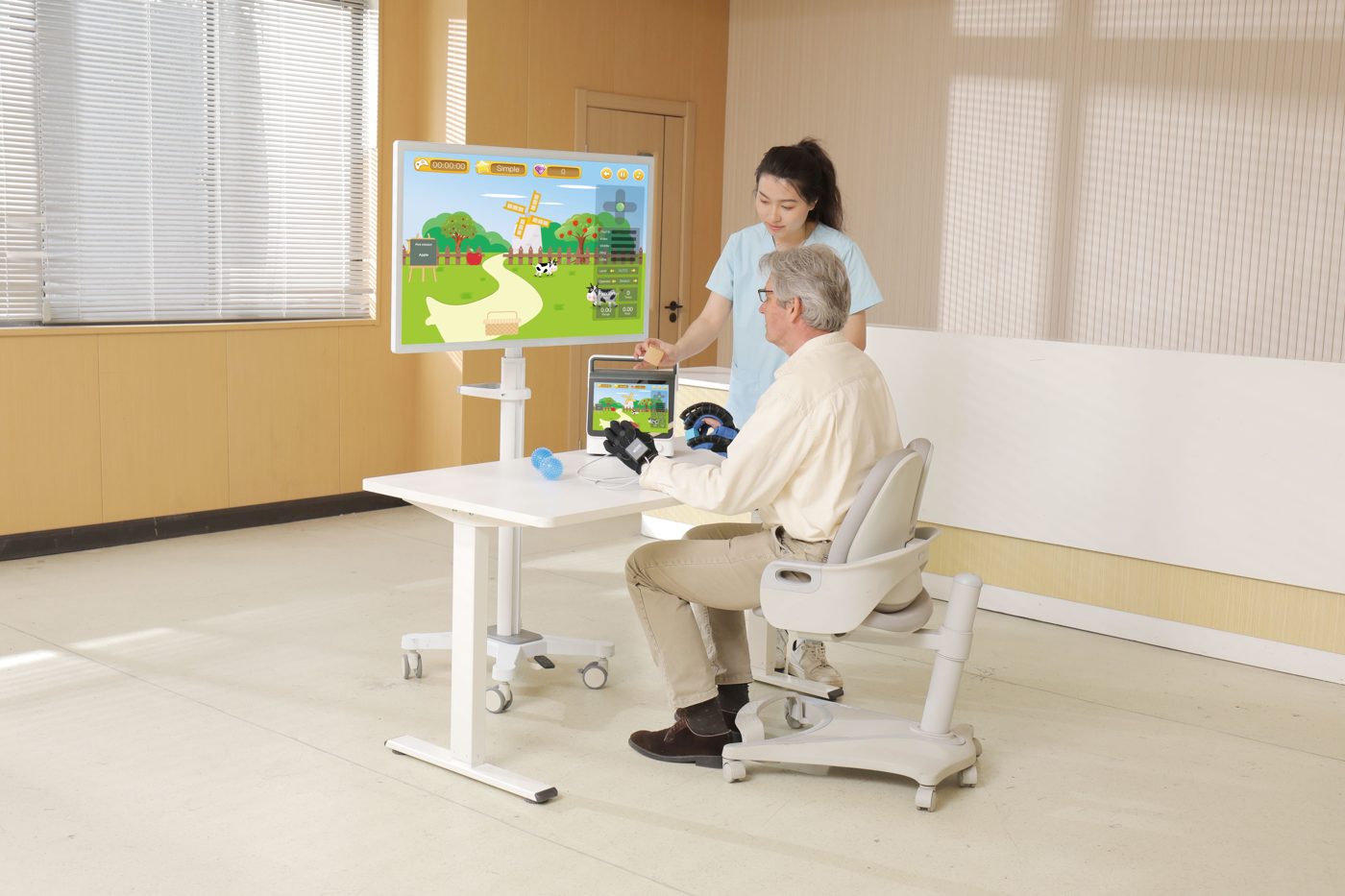
The practical challenge is that therapy hours are limited — in most health systems, a survivor may receive only a few hours of one-on-one therapy per week. This is where home training between sessions becomes decisive. Compact home rehabilitation equipment such as the Syrebo C10 hand rehabilitation glove or the lighter C11 soft robotic glove lets survivors add hundreds of guided finger flexion-extension repetitions a day at home, with mirror-glove modes that borrow the same logic as mirror therapy: the healthy hand leads, and the affected hand follows.
Again, "typical" is a range, not a promise: some survivors walk independently by month three; others are still working on sitting balance. Progress in one function (like walking) often runs ahead of another (like fine hand control) — hand recovery is usually the slowest, which is exactly why it deserves consistent daily attention.
Somewhere between month three and month six, many families notice improvement slowing down. This is often called the plateau, and it can feel discouraging — some survivors are even told that whatever function they have at six months is all they will get.
The research tells a more nuanced story. The plateau is real in the sense that spontaneous recovery slows. But a plateau in spontaneous recovery is not the same as the end of recovery. What frequently plateaus is not the brain's capacity to change — it is the training dose. Formal therapy often ends around this time, and without structured practice, repetitions collapse from hundreds per day to nearly zero.
For this stretch of the stroke recovery timeline, the goal is simple to state and hard to do: keep the training volume up after discharge.
Typical expectations: between months three and twelve, gains tend to be slower and more task-specific — buttoning a shirt, holding a cup — rather than dramatic. Slower does not mean over.
For decades, the assumption was that recovery stops at one year. Modern neuroscience disagrees. Neuroplasticity — the brain's ability to reorganize in response to training — persists for life. Clinical trials of intensive training in the chronic phase, including the CIMT literature, have documented measurable functional improvement in survivors one year or more after stroke. Improvement is generally slower and requires more deliberate effort than in the golden window, but the door does not close.
In the chronic phase, the emphasis shifts from raw repetitions toward task-oriented training: practicing real activities — grasping, releasing, carrying, manipulating objects — that map directly onto daily life. Devices can help keep this engaging over the long term; for example, the Syrebo E12E hand rehabilitation robot combines guided hand training with interactive game-based tasks, which helps with the hardest problem of chronic-phase rehab: staying motivated month after month.
If you are more than a year post-stroke and were told nothing more can change, it is reasonable to ask your rehabilitation physician about a renewed, structured training block. Many survivors are surprised by what consistent practice can still achieve — with the understanding that results vary from person to person.
There is no single answer — recovery is highly individual. As a general pattern, the fastest improvement typically occurs in the first three months, meaningful gains often continue through the first year, and slower, training-driven improvement remains possible for years afterward. Your medical team can give the most realistic estimate for your specific situation.
A practical way to divide it: the acute phase (first 24–72 hours, medical stabilization), early recovery (weeks 1–4, spontaneous recovery begins and passive movement starts), the golden window (months 1–3, high-repetition training), the post-plateau phase (months 3–12, maintaining training dose at home), and the chronic phase (1 year and beyond, task-oriented training). Clinicians also use the six Brunnstrom stages to describe motor recovery specifically.
Yes. Studies of intensive, structured training in the chronic phase have documented functional improvements well beyond one year post-stroke, because neuroplasticity persists for life. Progress is usually slower than in the early months and depends on consistent practice, so improvement is possible but not guaranteed for every individual.
Research on motor learning suggests the affected hand benefits from hundreds of repetitions per day — more than scheduled therapy sessions alone usually provide. Most survivors work toward multiple short home sessions daily (for example, 20–30 minutes, two to three times a day), but the right dose depends on fatigue, spasticity, and overall condition, so follow the plan set by your therapist.
First, discuss it with your rehabilitation team — an apparent plateau sometimes reflects reduced training volume after therapy ends rather than exhausted potential. Options often include a renewed structured training block, addressing spasticity, and re-establishing a daily home program with sufficient repetitions. A plateau in speed of recovery is not the same as the end of recovery.
This article is for educational purposes only and is not a substitute for professional medical advice, diagnosis, or treatment. Every stroke and every recovery is different — always follow the guidance of your physician and rehabilitation team.