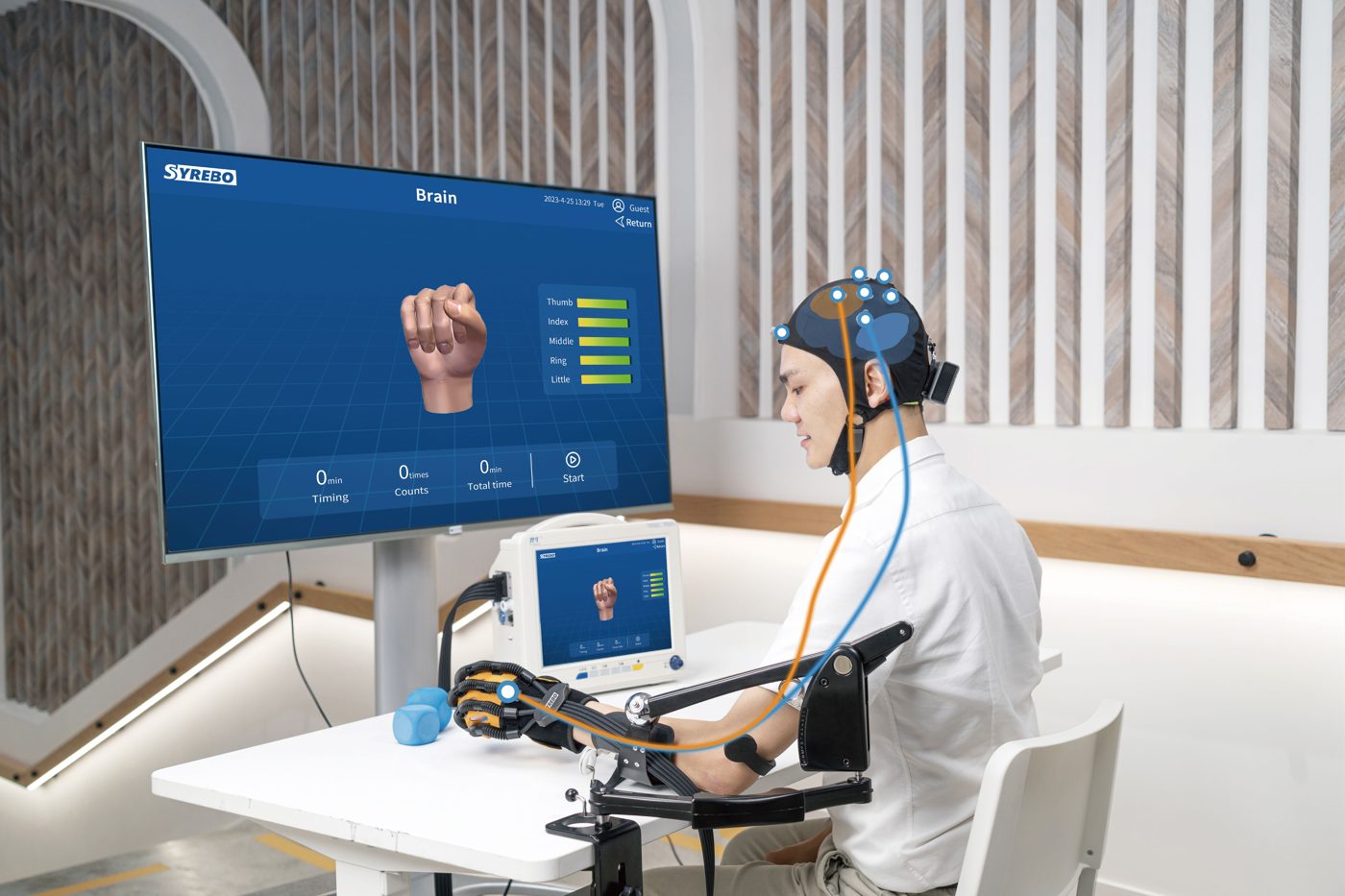

In August 2025, Syrebo rehabilitation technology entered a hospital-side professional dialogue in Hong Kong. An August 18 report from Nihao Zhangjiang described Syrebo demonstrating brain-computer interface (BCI) rehabilitation technology at Princess Margaret Hospital and Tung Wah Hospital.
The report gives international clinical teams a useful view of how Syrebo introduces emerging rehabilitation technology in real care environments. It does not establish procurement, routine clinical use, institutional endorsement or treatment outcomes, and it did not specify the product model or BCI channel count used in the demonstrations.
| Reported period | August 2025; exact session dates were not stated |
| Setting | Public hospitals in Hong Kong |
| Source | Nihao Zhangjiang report published August 18, 2025 |
| Technology | BCI-assisted rehabilitation and robotic hand training; exact configuration not reported |
The public report identified Princess Margaret Hospital and Tung Wah Hospital as demonstration settings. Naming the institutions here reflects that attributed report; it should not be read as an endorsement by either institution.
The durable value of the event is the professional exchange itself. Hospital teams could examine how non-invasive brain-signal sensing may connect with assisted hand training, ask workflow and documentation questions, and consider where the technology category may fit within professionally guided rehabilitation.
At a category level, a non-invasive BCI records EEG activity and analyzes patterns associated with movement intention. A rehabilitation system may connect that signal to an assistive device, such as a soft robotic hand trainer, so intended movement is paired with guided practice. Sensors, algorithms, training modes and device functions vary by system.
This technology is designed to support professionally guided rehabilitation practice. It does not read thoughts or replace a therapist, and outcomes depend on the individual and the training plan. Clinical suitability and training parameters depend on the user and on the exact device and protocol being considered.
A useful demonstration gives clinical teams space to examine more than a feature list. Questions typically include how the system fits therapist workflow, which training stages it is intended to support, how it is fitted and cleaned, what feedback it records, what evidence supports the device or device class, which regulatory documentation applies, and what onboarding and technical support are available.
That evaluation mindset is central to responsible innovation. It helps move the conversation from a promising technical concept to a practical implementation plan for a specific care setting.
Hong Kong brings together internationally connected clinical practice, multilingual professional teams and a strong focus on operational evaluation. Dialogue with hospital teams there gives Syrebo a valuable perspective on how rehabilitation technology must be explained, documented and supported across different care environments.
The August 2025 hospital-side demonstrations are distinct from the April 2026 visit by Hong Kong rehabilitation therapists to Syrebo, where a newer 32-channel BCI system was presented. Together, the two exchanges show an ongoing professional conversation while preserving the different date, location and technology details of each event.
For international distributors and providers, the broader message is practical: Syrebo pairs innovation in soft robotics and BCI with clinical education, product documentation, training and service. The company’s later 32-channel BCI development is documented separately and should not be projected backward onto the August 2025 demonstration.
A report published on August 18, 2025 described demonstrations during August 2025 at public hospitals in Hong Kong. It did not provide exact session dates.
The report identified Princess Margaret Hospital and Tung Wah Hospital. Naming them here reflects the attributed source and does not imply procurement, routine clinical use or endorsement.
The August 2025 source did not specify a model or channel count, so this article does not identify the demonstrated configuration as the later 32-channel system.
No. A professional demonstration allows a clinical team to examine and discuss a technology. It does not by itself establish procurement, routine clinical use, endorsement or treatment outcomes.
At a category level, it analyzes non-invasive EEG patterns associated with movement intention and may connect them with guided rehabilitation practice using an assistive device. Functions vary, and use should be guided by qualified professionals.
Contact Syrebo with the care setting, workflow and target market. The team can discuss the appropriate product category, available documentation, demonstration options, training and implementation support.
Discuss your clinical workflow, documentation and evaluation needs with Syrebo.
Contact our team