| Study type | Randomized controlled study |
| Participants | 60 stroke patients with hand dysfunction |
| Journal | Journal of New Medicine, 55(6):397–402, 2024 |
| Key result | Innovative robotic mirror therapy (SY-HR08) produced significantly greater upper-limb and daily-living gains than traditional mirror therapy |
Most rehabilitation studies ask whether adding a device beats standard care. This 2024 randomized controlled study asked a sharper, more revealing question: when both groups already receive mirror therapy, does making the mirror therapy robotic actually change the outcome? Sixty stroke patients with hand dysfunction were split into two groups — one trained with an innovative robotic mirror therapy delivered by the SY-HR08 hand rehabilitation robot, the other with traditional mirror therapy — on top of the same conventional rehabilitation. Both groups improved. But the innovative robotic mirror therapy group improved significantly more in upper limb function and everyday living ability. Because this was a head-to-head randomized comparison, it isolates a single variable — the robotics — and shows it carried real, added value.
Mirror therapy is a well-established stroke rehabilitation technique: by watching the reflection of the unaffected hand, the brain is prompted to re-activate the motor pathways of the impaired hand, supporting neuroplastic recovery. (For the underlying mechanism, see our explainer on the science and application of mirror therapy.) But traditional mirror therapy is largely passive: it supplies the visual illusion, yet the intensity and repetition depend entirely on the patient's own effort. The researchers wanted to know whether a robotic system that actively guides and drives the hand through the mirrored movements — rather than only reflecting them — could make the same therapeutic principle work harder.
The practical message is about why robotic mirror therapy works better, not just that it does. Traditional mirror therapy supplies the visual illusion; a robotic system like the SY-HR08 adds active, guided, high-repetition movement to that illusion — pairing the brain's visual feedback with real, assisted motion of the affected hand. That combination is what appears to drive the extra gains. The finding sits alongside a separate randomized controlled trial in which adding a Syrebo robotic glove outperformed conventional therapy alone: together they point the same way — robotics amplify proven rehabilitation methods rather than replacing them. Syrebo's clinical rehabilitation systems are built to deliver exactly this kind of guided, repetitive training under professional supervision. As always, the right device and program depend on the individual and should be guided by a rehabilitation professional.
Chen, T., Liu, S. X., Chen, X. L., Mao, L., Li, D. B., & Gan, L. Y. (2024). Rehabilitation effect of innovative mirror therapy on upper limb impairment in stroke patients. Journal of New Medicine, 55(6), 397–402. DOI: 10.3969/j.issn.0253-9802.2024.06.001
In this 2024 randomized controlled study of 60 stroke patients with hand dysfunction, both approaches helped, but innovative robotic mirror therapy (SY-HR08) produced significantly greater gains in upper limb function and daily living ability than traditional mirror therapy. Results vary by individual, and rehabilitation should be guided by your medical team.
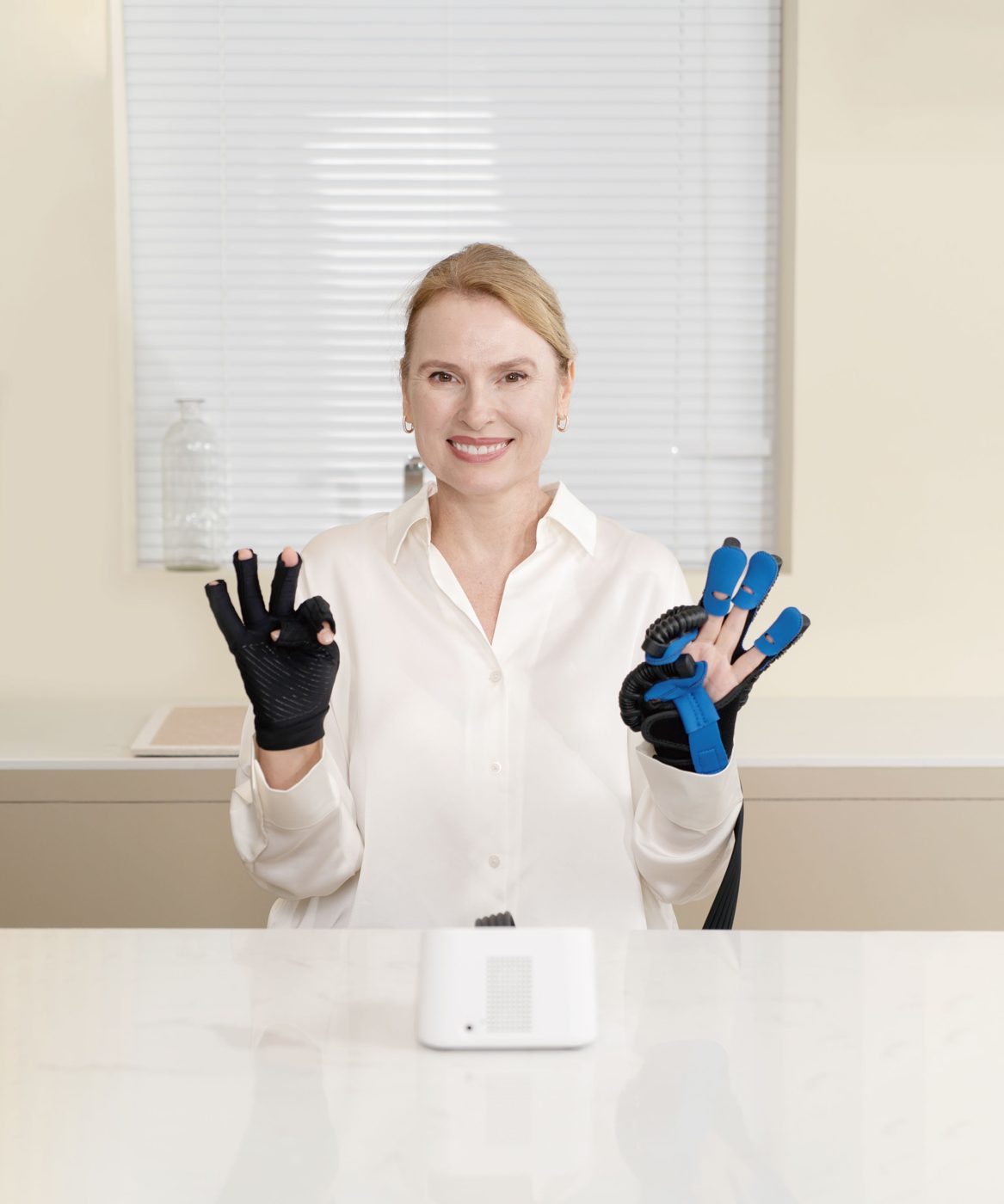
Traditional mirror therapy relies on the visual reflection of the unaffected hand while the patient tries to move the impaired hand themselves. Innovative robotic mirror therapy uses a hand rehabilitation robot such as the SY-HR08 to actively guide and drive the affected hand through the mirrored movements, adding assisted, high-repetition motion to the visual feedback.
Participants trained 5 sessions per week for 4 weeks, on top of conventional rehabilitation.
This article summarizes published research for educational purposes. It is not medical advice and does not guarantee individual outcomes. Always consult a qualified healthcare professional about stroke rehabilitation.